Hands and cameras, together
A single model predicts bilateral hand motion, camera motion, and intrinsics. It reconstructs world-frame hand trajectories without separate hand detection, SLAM, or test-time optimization.
1 Tsinghua University2 Microsoft Research
* Intern at Microsoft Research
The video could not be loaded. Please reload the page or try another browser.
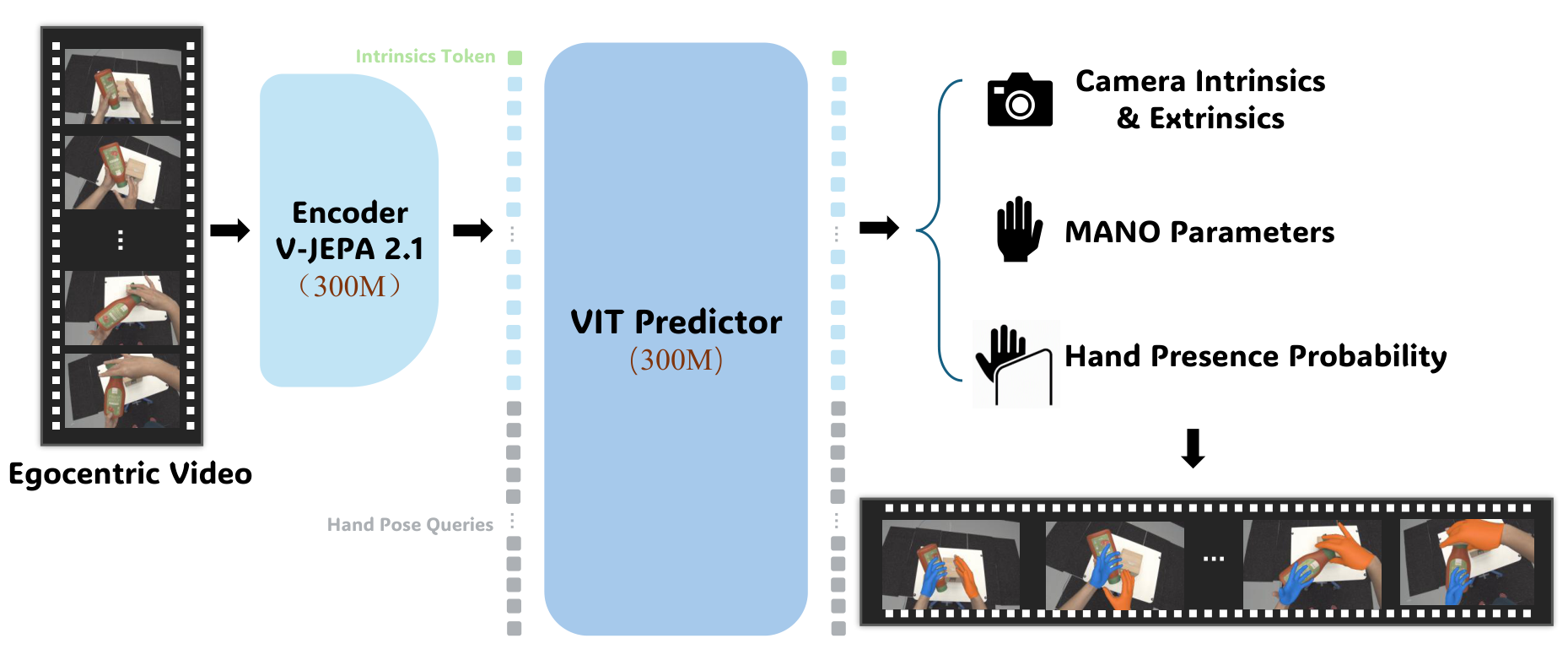
Egocentric video supports diverse applications, including robot learning, augmented reality, and human activity understanding. Recovering metric 3D hand trajectories from such video requires estimating both hand motion and camera egomotion to express the hands in a consistent reference frame. Many existing pipelines recover hand and camera motion in separate stages, combining hand detection, hand reconstruction, camera tracking, and trajectory refinement. We present V-JEPA Hand, a simple feed-forward video model that jointly reconstructs bilateral hand motion and camera motion from egocentric clips. It uses a self-supervised V-JEPA 2.1 encoder to extract spatio-temporal features from full-frame video and a query-based predictor to decode these features into per-frame hand poses, hand presence, and camera motion. We use the predicted camera motion to express the hand trajectories in a common world frame. The model accepts known focal lengths or predicts them when unavailable. It reconstructs each clip in a single forward pass. We train both components end to end in a single stage on a mixture of diverse pseudo-labelled videos and high-precision 3D annotations. A single model achieves the lowest coverage-aware mean per-joint position error (MPJPE) among comparable baselines on ARCTIC, HOT3D, and EgoStandard. It also yields lower world-frame trajectory errors than the compared SLAM-based pipelines. Ablations support the benefits of video pretraining, temporal context, and mixed supervision. V-JEPA Hand achieves a forward-pass throughput of 93.4 FPS on a single RTX A6000. We will publicly release our code, model weights, and training scripts.
One video encoder. One predictor. Joint reconstruction. Full-frame video features from V-JEPA 2.1 are decoded into hand pose, hand presence, camera motion, and focal lengths. The predicted cameras place the hands in a common world frame.
Detection ↑ · Pose and motion errors ↓
Accurate hands across three benchmarks. V-JEPA Hand achieves the lowest coverage-aware MPJPE among comparable baselines on ARCTIC, HOT3D, and EgoStandard.
| Detection | 3D Pose | Orient. & Position | Temporal | |||||||||||
|---|---|---|---|---|---|---|---|---|---|---|---|---|---|---|
| Method | Acc↑ | Rec↑ | F1↑ | MP-p↓ | MP↓ | PA-p↓ | PA↓ | EP-p↓ | EP↓ | GO-p↓ | GO↓ | CT-p↓ | CT↓ | Jit↓ |
| ARCTIC | ||||||||||||||
| WiLoR | 0.909 | 0.949 | 0.971 | 21.11 | 15.52 | 12.74 | 6.70 | 65.56 | 28.84 | 17.68 | 11.74 | 0.077 | 0.050 | 25.97 |
| HaMeR | 0.873 | 0.943 | 0.958 | 30.78 | 25.10 | 16.02 | 9.44 | 64.85 | 28.45 | 25.14 | 18.67 | 0.093 | 0.063 | 14.78 |
| WildHands | 0.874 | 0.944 | 0.958 | 27.07 | 21.29 | 15.99 | 9.55 | 65.44 | 29.58 | 22.54 | 16.05 | 0.070 | 0.039 | 12.28 |
| HaWoR | 0.853 | 0.953 | 0.945 | 31.52 | 26.94 | 14.48 | 9.07 | 44.32 | 16.24 | 24.38 | 18.82 | 0.076 | 0.050 | 19.37 |
| ViDiHand | 0.997 | 0.999 | 0.999 | 21.67 | - | 9.82 | - | 12.41 | - | 14.64 | - | 0.047 | - | 3.18 |
| Ours | 0.996 | 0.998 | 0.999 | 15.59 | 15.36 | 6.84 | 6.59 | 8.99 | 8.85 | 12.46 | 12.18 | 0.032 | 0.031 | 6.09 |
| HOT3D | ||||||||||||||
| WiLoR | 0.810 | 0.879 | 0.922 | 39.38 | 26.09 | 23.10 | 7.57 | 79.90 | 22.11 | 32.51 | 16.49 | 0.103 | 0.048 | 17.19 |
| HaMeR | 0.719 | 0.880 | 0.886 | 67.09 | 57.96 | 25.09 | 10.26 | 70.66 | 15.40 | 50.01 | 36.35 | 0.106 | 0.055 | 21.09 |
| WildHands | 0.425 | 0.600 | 0.609 | 80.23 | 42.99 | 61.89 | 12.40 | 275.39 | 37.14 | 84.35 | 38.82 | 0.250 | 0.076 | 25.30 |
| HaWoR | 0.733 | 0.895 | 0.875 | 28.79 | 16.71 | 20.68 | 7.64 | 66.60 | 8.16 | 25.01 | 10.50 | 0.086 | 0.039 | 13.41 |
| ViDiHand | 0.948 | 0.974 | 0.983 | 21.51 | - | 11.38 | - | 14.95 | - | 15.83 | - | 0.040 | - | 3.74 |
| Ours | 0.971 | 0.979 | 0.980 | 14.42 | 12.04 | 8.24 | 5.72 | 16.81 | 5.71 | 9.90 | 6.52 | 0.026 | 0.014 | 5.74 |
| EgoStandard | ||||||||||||||
| WiLoR | 0.949 | 0.971 | 0.982 | 35.19 | 32.16 | 11.11 | 7.35 | 37.09 | 12.74 | 25.88 | 22.13 | 0.089 | 0.080 | 15.53 |
| HaMeR | 0.986 | 0.992 | 0.994 | 37.37 | 36.60 | 8.27 | 7.26 | 18.06 | 11.45 | 26.37 | 25.37 | 0.093 | 0.090 | 18.35 |
| WildHands | 0.514 | 0.658 | 0.659 | 69.22 | 33.83 | 55.04 | 12.29 | 325.25 | 53.66 | 74.03 | 31.84 | 0.214 | 0.099 | 20.10 |
| HaWoR | 0.883 | 0.901 | 0.937 | 33.38 | 23.36 | 20.11 | 8.62 | 91.58 | 8.00 | 26.58 | 12.81 | 0.089 | 0.058 | 13.95 |
| Ours | 0.990 | 0.995 | 0.997 | 16.97 | 16.30 | 8.01 | 7.29 | 11.10 | 6.51 | 10.60 | 9.84 | 0.045 | 0.043 | 4.88 |
Gray ViDiHand results on HOT3D use a different split and are reference-only.
WiLoR, HaMeR, and WildHands are single-frame methods; HaWoR, ViDiHand, and ours are multi-frame methods. We follow ViDiHand's evaluation protocol, except that pose metrics without the -p suffix are computed on each method's own intersection of predictions and ground truth (true positives). ViDiHand results are taken from its paper (ViDiHand); its HOT3D row (gray) uses a different split and is shown for reference only, without direct comparison or ranking.
W-MPJPE / WA-MPJPE (mm) · RTE (%) ↓
More accurate trajectories in a shared world frame. V-JEPA Hand reduces W-MPJPE, WA-MPJPE, and RTE compared with the evaluated SLAM-based pipelines on all three benchmarks.
| ARCTIC | HOT3D | EgoStandard | |||||||
|---|---|---|---|---|---|---|---|---|---|
| Method | W-MP↓ | WA-MP↓ | RTE↓ | W-MP↓ | WA-MP↓ | RTE↓ | W-MP↓ | WA-MP↓ | RTE↓ |
| WiLoR+SLAM | 63.36 | 34.13 | 29.78 | 74.78 | 28.42 | 40.21 | 90.67 | 41.54 | 26.27 |
| HaMeR+SLAM | 69.05 | 33.78 | 28.21 | 105.10 | 35.08 | 47.31 | 94.86 | 42.74 | 27.16 |
| HaWoR | 106.05 | 55.38 | 48.92 | 63.08 | 27.60 | 51.02 | 90.23 | 45.02 | 35.93 |
| Ours | 35.86 | 19.72 | 17.58 | 34.08 | 16.18 | 28.15 | 66.35 | 32.91 | 22.37 |
All four methods are evaluated on the same common true-positive hand-frames.
All methods are evaluated on the same hand-frames, using the intersection of true positives across the four compared methods. W-MPJPE and WA-MPJPE are in mm; RTE is in %. Lower is better.
Recovering hands in a consistent world frame requires understanding both hand motion and camera motion. V-JEPA Hand learns them together, directly from video.
A single model predicts bilateral hand motion, camera motion, and intrinsics. It reconstructs world-frame hand trajectories without separate hand detection, SLAM, or test-time optimization.
V-JEPA 2.1 video pretraining provides spatio-temporal features. We fine-tune the encoder and predictor together in one stage on four datasets: Ego4D, in-house recordings, ARCTIC, and HOT3D. Ego4D and in-house videos are pseudo-labelled with VITRA. EgoStandard is held out for evaluation.
The lowest coverage-aware MPJPE among comparable baselines on all three benchmarks, with single-GPU forward throughput of 93.4 FPS on RTX A6000 and 115.1 FPS on A100. Both are measured on the same 100 real-video clips at batch size one with BF16, excluding detection and postprocessing.
A feed-forward approach to turning egocentric video into 3D hand-motion annotations.
@misc{li2026vjepahandsimpleaccurate,
  title={V-JEPA Hand: Simple, Accurate and Fast 3D Hand and Camera Trajectory Recovery from Egocentric Videos},
  author={Ruicheng Li and Qixiu Li and Yu Deng and Sicheng Xu and Jiaolong Yang and Baining Guo},
  year={2026},
  eprint={2610.26780},
  archivePrefix={arXiv},
  primaryClass={cs.CV},
  url={https://arxiv.org/abs/2610.26780},
}